
Health library
Back to health libraryHow HPV vaccination protects men
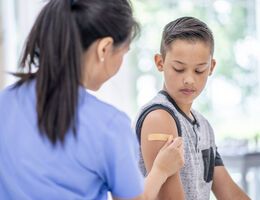
June 15, 2026—Vaccines play an important role in helping boys grow up to be healthy men throughout their lives. That's even true when it comes to preventing cancer.
The HPV vaccine was introduced several years ago. It provides protection from many types of human papillomavirus infections that cause cancer.
Much of the early focus of this vaccine was on cervical cancer prevention in women. However, HPV vaccines also help prevent several types of cancer that affect men, such as mouth, throat, anal and penile cancers.
How does HPV cause cancer in men?
HPV is a very common virus that can infect both men and women. Most HPV infections clear up on their own without causing any problems. But some high-risk types can last for years in the body and eventually change cells in ways that may cause cancer.
One HPV-related throat cancer—oropharyngeal cancer—is more than four times as common in men as in women, according to the Association of American Medical Colleges. And the number of new cases of this cancer is increasing.
Vaccination reduces risk by half
The HPV vaccine is very effective. Now, a study published in JAMA Oncology offers new evidence about how well it works to protect boys when they grow up. Researchers looked at data on more than 510,000 vaccinated males ages 9 to 26 years. They compared that to data from the same number of unvaccinated males. They followed both groups for about a decade.
Among the findings: Boys and young men who received a vaccine against nine strains of HPV were about half as likely to be diagnosed with an HPV-related cancer years later, when compared to unvaccinated males. Specifically, the risk was:
- 42% lower for those who were vaccinated when they were 9 to 14 years old.
- 50% lower for those vaccinated when they were 15 to 26 years old.
As of 2024, about 77% of boys ages 13 to 17 in the U.S. had been vaccinated against HPV. In the study, the risk of getting an HPV-related cancer was lowest among those who were vaccinated as older teens or adults. But that doesn't necessarily mean later vaccination is better. That finding could reflect other factors. Experts still recommend HPV early in life, before a person is sexually active.
Vaccination starts with preteens
HPV vaccines work best when people get them before they may be exposed to an HPV virus, which can spread through sexual contact. That's why the HPV vaccine is recommended for children. Preteens should get the HPV vaccine at age 11 or 12. But it can be given to children as young as age 9.
And it's not too late to catch up on any shots your teen may have missed. In fact, everyone up to age 26 can get the HPV vaccine, if they haven't been vaccinated already.
The vaccine does provide less benefit the longer you wait to get it. That's because you may have already been exposed to HPV by then. But even some people as old as 45 may choose to get the HPV vaccine if they and their doctor think it may still help them.
Talk to your doctor to learn more about the HPV vaccine for your children or for you. You can also learn more about vaccines kids may need and when to get them by viewing our infographic.
Sources
- Association of American Medical Colleges. "HPV Cancers Are on the Rise." https://www.aamc.org/news/hpv-cancers-are-rise.
- Centers for Disease Control and Prevention. "Basic Information About HPV and Cancer." https://www.cdc.gov/cancer/hpv/basic-information.html.
- Centers for Disease Control and Prevention. "HPV and Oropharyngeal Cancer." https://www.cdc.gov/cancer/hpv/oropharyngeal-cancer.html.
- Centers for Disease Control and Prevention. "HPV-Associated Cancer Diagnosis by Age." https://www.cdc.gov/cancer/hpv/diagnosis-by-age.html.
- Centers for Disease Control and Prevention. "HPV Vaccination." https://www.cdc.gov/hpv/vaccines.
- JAMA Oncology. "Nine-Valent Human Papillomavirus Vaccination and Related Cancers in Males." https://jamanetwork.com/journals/jamaoncology/article-abstract/2847524.
- National Foundation for Infectious Diseases. "Facts About HPV." https://www.nfid.org/resource/facts-about-hpv.
- University of Minnesota. "HPV Vaccination Cuts Cancer Risk in Men by About Half, Study Suggests." https://www.cidrap.umn.edu/human-papillomavirus-hpv/hpv-vaccination-cuts-cancer-risk-men-about-half-study-suggests.